A solar eclipse usually sends everybody skyward: heads tilted back, protective glasses on, phones pointed at a vanishing disc. Zorawar Sidhu and Rob Swainston proposed the opposite. For Looking Down, staged at the University at Buffalo’s Anderson Gallery around the April 8, 2024 total solar eclipse, perforated plywood panels turned sunlight into shifting projections on the ground. The celestial event arrived underfoot—small, shared, and visible without asking anyone to stare directly at the sun.
The panels had a previous job. Sidhu and Swainston salvaged them from New York City storefronts boarded up in 2020 and 2021, when plywood became a blunt, familiar piece of emergency architecture: cover the glass, close the opening, keep out. Here, constellations of holes made that weathered surface porous. As the moon moved in front of the sun, light passing through the perforations produced changing eclipse projections on the ground.

That reversal is the work’s cleanest move. A board-up normally blocks a view; a pinhole makes one. Looking Down did not merely add salvaged material to an eclipse watch. It turned a surface associated with the civic strain of 2020 and 2021 into an optical device, while making the ground a shared projection plane. An eclipse, ordinarily all distance and spectacle, became a field of light to follow as it shifted. Practical, certainly—but also a little strange once the usual instruction to look up has been withdrawn.
The temporary installation ran from April 6 through July 26, 2024, with an eclipse-viewing program on April 8. It was made with UB School of Architecture faculty Christopher Romano, Michael Hoover, and Randy Fernando, together with the artists and UB Art Galleries staff. That credit line matters. The project needed structural thinking, a public setting, and a safe way of observing a solar event—not simply an image placed outdoors. Its stripped-down equation, panel plus holes plus sun, rested on an exact arrangement of material and use.

Sidhu and Swainston are known for woodcuts that bring historical print processes into contact with contemporary image systems and social questions. Their 2021 woodblock July 4, from the Doomscrolling series, is held by the National Gallery of Art. The pair have also discussed their woodcuts in relation to media saturation, climate change, civil unrest, political anxiety, and the deliberately slow labor of printmaking. Those concerns make the battered plywood in Looking Down feel less like found décor than a support carrying the conditions from which it came.
Seen through that printmaking logic, Looking Down is an expanded woodcut. The act of cutting—or, here, perforating—still determines what image can appear. But ink gives way to sunlight, paper gives way to the ground, and the edition lasts only as long as the changing sky permits. The installation trades the framed, stable result for a temporary public apparatus. Its image could not be hung on a wall or held still; it depended on a particular eclipse, a particular material, and people gathering in the right place.

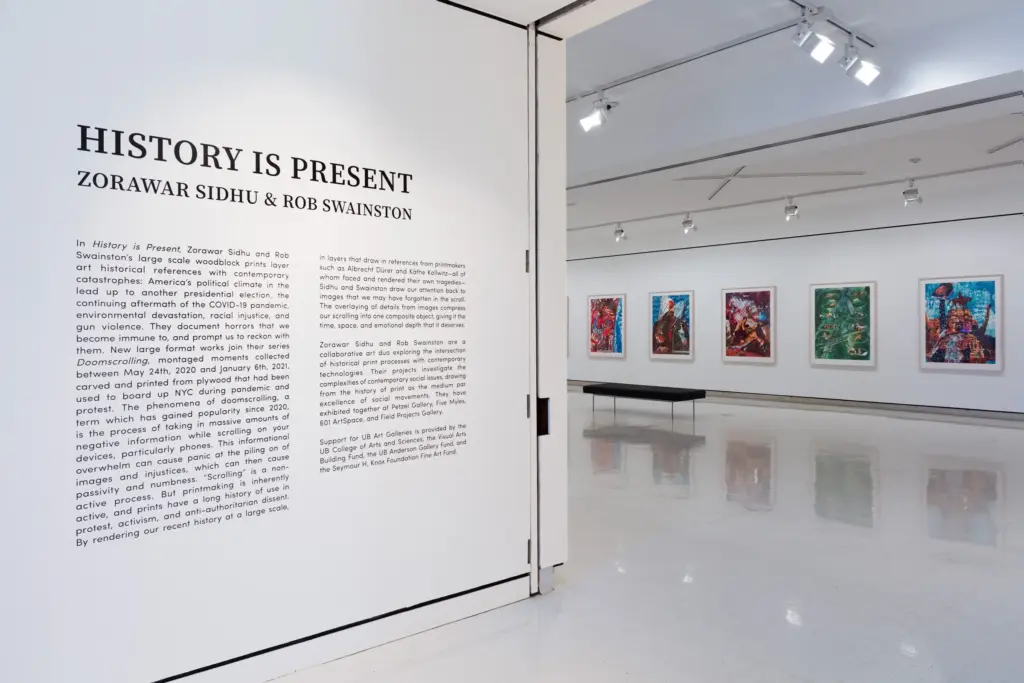
Looking Down accompanied History is Present, the duo’s 2024 exhibition at the Anderson Gallery. Installation views documented on Sidhu’s project site show large framed, multicolor prints distributed across the gallery: dense images with a markedly different scale and duration from the outdoor light projections. The pairing makes sense. Both the exhibition and the eclipse work ask what happens when an image is routed through a physical system—layered printing in one case, punctured plywood and sunlight in the other.
There is something usefully unheroic about the result. No giant model sun, no attempt to compete with the eclipse itself. Just old plywood, a pattern of holes, and a reason to notice where the light was landing. The marks in the panels did not depict the event in advance; they made its movement temporarily legible. A material made to deny access briefly became a communal viewing instrument. The sky still performed the spectacular part; Sidhu and Swainston changed the angle from which it could be seen.

Sources and further looking
- Looking Down — UB Art Galleries, University at Buffalo
- UB Art Galleries mark eclipse with special exhibit, installation — UBNow, University at Buffalo
- 2024: History is Present — Zorawar Sidhu
- July 4 — National Gallery of Art
- Zorawar Sidhu & Rob Swainston — Petzel
- Episode 247: Zorawar Sidhu & Rob Swainston — Hello, Print Friend
Images are shown for editorial commentary and remain the property of their respective artists and photographers. Please contact Woke a Doodle regarding attribution, correction, or removal.