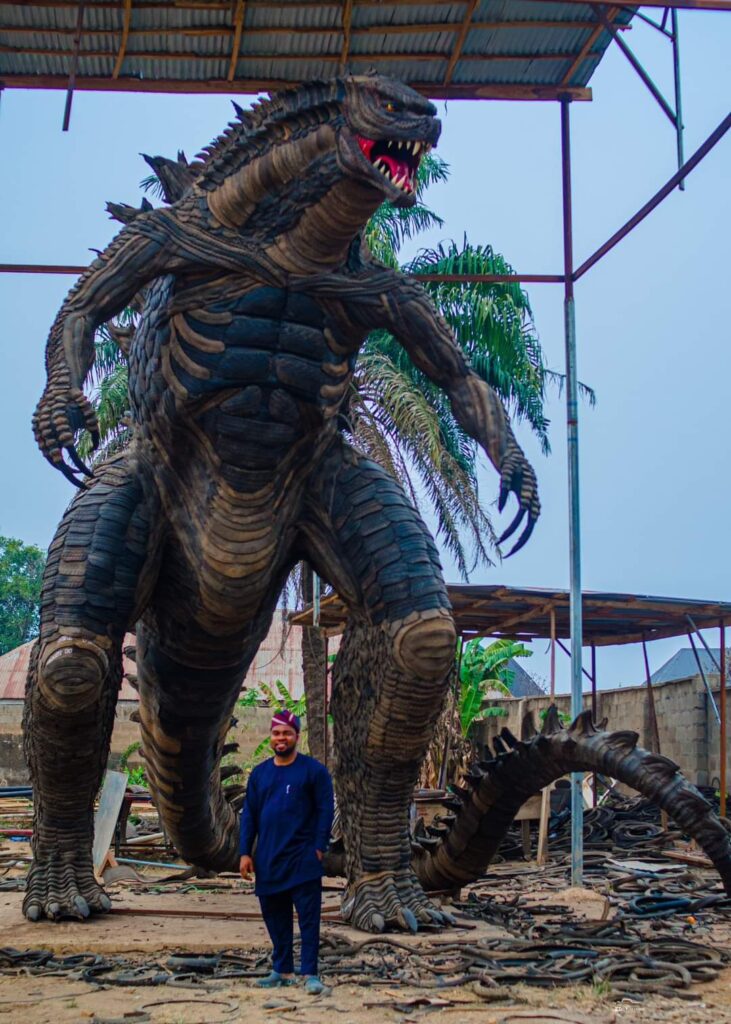
The first thing to look at is not Godzilla's face but his thighs. They are tiled with bands of tyre tread: chevrons, ribs, worn edges, pieces once designed to grip a road now overlapping like armor. Follow those strips upward and they change jobs. The tread becomes abdominal muscle, chest plate, tendon, scale, and the ridged skin around a roaring mouth. Only then does the height register. A person standing beneath Toyeeb Ajayi's sculpture barely reaches its shin.
Ajayi's Godzilla stands 24 feet tall at the Scrap Art Museum near Ile-Ife, Nigeria. After visiting the workshop in 2024, Babafemi Ojudu reported that its hide was assembled from more than 3,000 pieces cut from motorcycle, bicycle, and truck tyres and held with roughly 6,000 screws. Those numbers explain the visual density. This is not one clever material substitution repeated at giant scale; it is thousands of small decisions about which tread can imitate a rib, where a sidewall will bend, and how a strip of rubber should meet the next one.
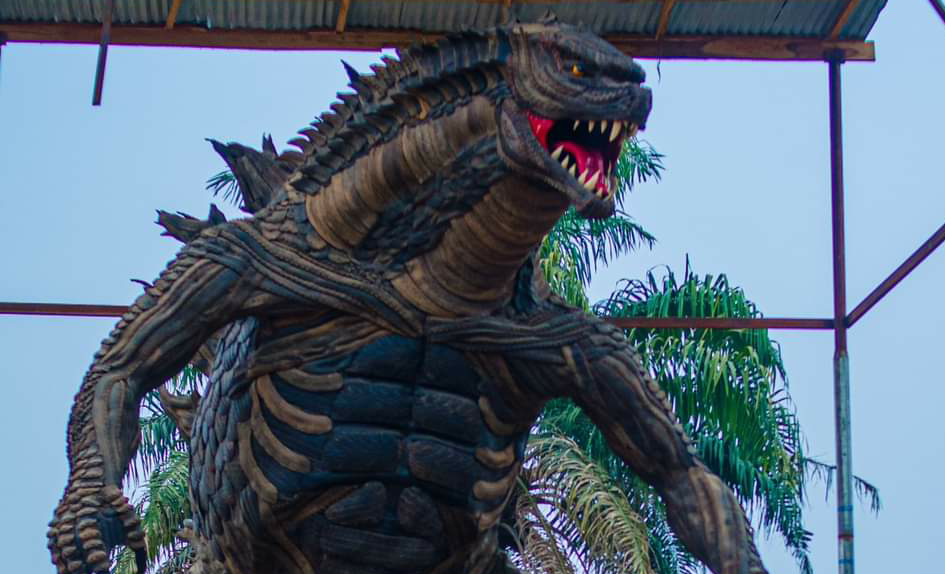
Online, the sculpture is repeatedly described as entirely made from tyres. The photographs make the rubber skin obvious, but a body this large also presents a structural problem, and Ajayi's earlier work offers a more useful clue. An International Institute of Welding catalog documents his 2022 Gorilla as discarded tyres carried by TMT bars, mild-steel plates, and C channels, shaped with electric-arc and plasma-arc welding. The available sources do not itemize Godzilla's internal frame, so it is better to see the creature as both sculpture and fabrication: a carefully built body wearing waste rubber as skin.
Ajayi is a Nigerian sculptor and Auchi Polytechnic graduate who has worked with used tyres and scrap materials for years. Accounts of the practice were circulating by 2016, well before this Godzilla began doing laps around the internet. His workshop context matters too. Ojudu encountered the sculpture at the Scrap Art Museum, a studio founded by scrap-metal artist Dotun Popoola where younger artists also work among piles of material waiting to become something else. In the photographs, the loose tyre offcuts at Godzilla's feet make the workshop look almost like the monster is shedding.
The surface rewards that workshop view. Broad sidewalls wrap the belly in horizontal bands. Narrow tread strips run down the arms like exposed tendons. Small pointed cuts gather into scales across the back, while heavier sections flare into dorsal plates. Tyres arrive with a vocabulary already molded into them—grooves, blocks, lettering, seams—and Ajayi does not sand that history away. He sorts and redirects it. The creature looks reptilian because the material is allowed to keep announcing what it used to be.

Godzilla was not Ajayi's first experiment at this scale. In 2022 he took part in an international art symposium in Jajpur, Odisha, India, where 20 invited artists made work from scrap and other reclaimed materials. His Gorilla measured 4.57 meters high, 2.5 meters wide, and two meters deep. The welding catalog places it within conversations about endangered animals, habitat loss, and waste, while also spelling out the industrial reality behind the finished animal. Recycling here involves heavy bars, plate, channels, welding machines, and a great deal of lifting.
Choosing giant animals and movie monsters lets that industrial labor remain visible without turning the work into a diagram. Godzilla is already a creature of catastrophic scale, so the leap from rubber scrap to kaiju feels strangely natural. Tyre tread has the right tough, armored texture; the long strips can read as sinew; the circular origin of the material survives in all those repeated curves. The ecological association is present, but first comes the ridiculous pleasure of seeing a seven-meter monster crouched under a corrugated workshop roof.
That combination of spectacle and environmental argument continued in Kong in a Cage, unveiled by Ecobank Nigeria at its Pan African Centre in Lagos in January 2025. Ajayi described the recycled-material installation as a dialogue about accountability and humanity's relationship with the environment. The cage changes the tone: Kong is still an attraction, but he is also caught inside a structure, turning the familiar beast into an image of nature constrained by human systems. The commission shows how Ajayi's tyre creatures can move from workshop marvels into public, commissioned art without losing their material bluntness.

By late 2025, Ajayi was also on the faculty of FREEE Recycle's art residency, mentoring emerging artists working with rubber, fiber, steel, and other reclaimed materials. That role is a useful counterpoint to the lone-genius story viral images tend to produce. The 24-foot Godzilla may be the object traveling fastest, but it belongs to a wider Nigerian network of artists, museums, recyclers, fabricators, and students testing what discarded material can carry—formally, culturally, and quite literally.
When the Godzilla photographs resurfaced on Reddit in August 2026, commenters repeatedly asked for the artist's name. Others questioned the viral phrase entirely from used tires. Both reactions are worth keeping. Ajayi should not disappear behind the object, and the object's engineering should not disappear behind an easy recycling caption. Look back at the ankle, where several kinds of tread stack into a joint sturdy enough to make a gigantic fictional animal stand. The wonder is not that rubbish somehow became Godzilla. It is that Ajayi made every cut, curve, screw, and support persuade us that it could.
Sources and further looking
- Toyeeb Ajayi — Instagram
- Turning Trash into Treasure: The Story of Toyeeb Ajayi and His Co-Artists — Babafemi Ojudu on Medium
- IIW 2023 Digital Collection: UN Sustainable Development Goals — International Institute of Welding
- Ecobank supports Nigerian artist with sustainable art initiative — African Press Agency
- FREEE Recycle Marks Five Years With Maiden Art Residency Exhibition — THISDAY
- Osun moves to drive sustainability in circular economy — BusinessDay Nigeria
- Ajayi Toyeeb — Artsy
- Nigerians built a 24-foot tall Godzilla statue out of recycled tires! — Godzilla-Movies.com
- This 24-foot Godzilla sculpture in Nigeria was built entirely from used tires — Reddit / r/Damnthatsinteresting
Images are shown for editorial commentary and remain the property of their respective artists and photographers. Please contact Woke a Doodle regarding attribution, correction, or removal.