At first, Chris McCaw’s landscapes can look almost conventional: a dark ridge, a bank of cloud, thin trees against a washed-out sky. Then the sun arrives as a problem in the paper. It might appear as a bright bead, a line dragged across the horizon, or a small, blunt hole. In the Sunburn works, daylight does not simply illuminate the scene. It stays in the camera long enough to leave a physical mark behind.
That mark is not a digital effect or a dramatic bit of post-production. McCaw builds large-format cameras himself and loads them with photographic paper rather than film, producing a unique paper negative with each exposure. Those exposures can last four hours or more. Focused sunlight can scorch or burn through the sheet; under extreme exposure, solarization reverses its tonal values, turning expected lights dark and darks pale. The landscape records time, while the paper records what that time did to it.
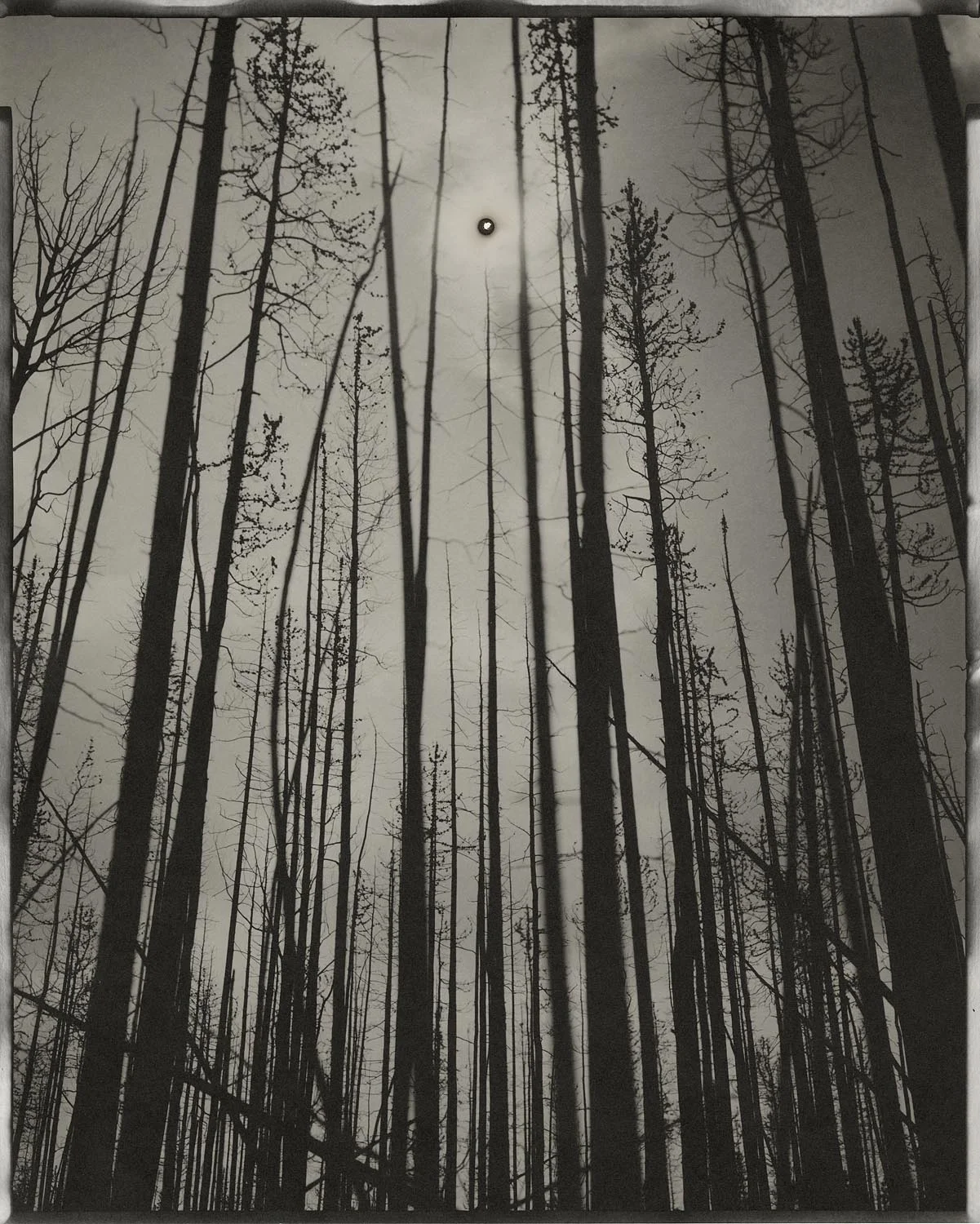
The process makes a familiar photographic arrangement suddenly strange. A camera is usually designed to regulate light, keeping the world legible through a measured dose of it. McCaw permits light to exceed that assigned role. The sun becomes subject, lamp, timer, and tiny destructive force all at once. A burn in the image is therefore not an illustration of heat. It is heat’s direct intervention in the object we are looking at.
McCaw traces the premise to an overnight exposure made in 2003. He left a camera open through sunrise and discovered that the daylight had physically altered the material inside. That accident produced a durable question: what happens when a photograph cannot stay separate from the conditions it depicts? Born in Daly City in 1971, McCaw lives and works in Pacifica. A 2011 Bay Area profile even described smoke coming from his camera bellows—less a metaphor than an equipment problem.
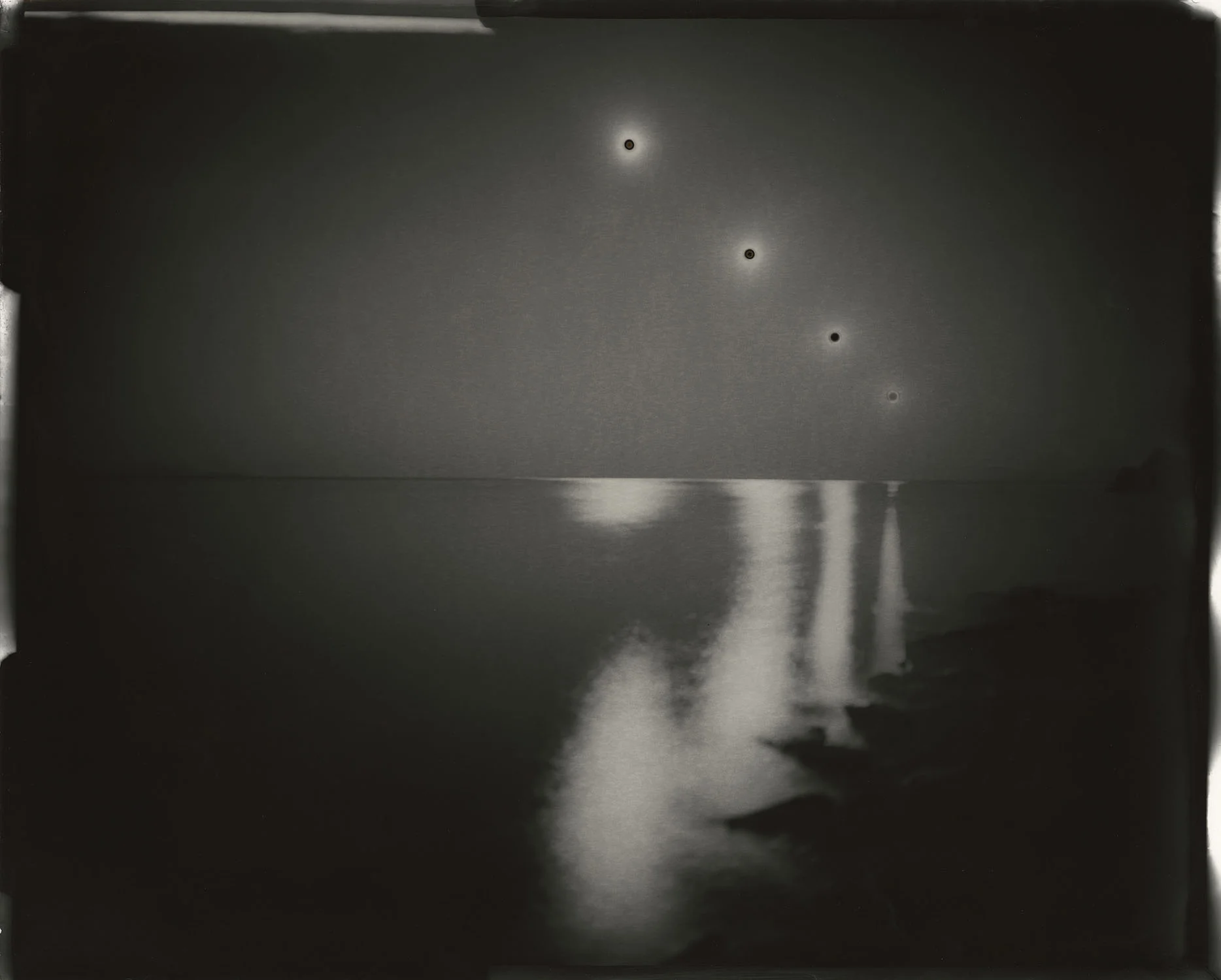
His Sunburn images are not records of one spectacular instant so much as compressed spans of time. In Sunburned, GSP #166, Mohave/Winter Solstice, a 2007 work held by the Metropolitan Museum of Art, four narrow gelatin-silver prints follow the winter sun’s low course over the Mojave Desert. The arc advances from panel to panel until a bright, broken section interrupts it. The sequence has the measured calm of scientific notation and the damage report of an object left too close to a flame.
Scale and repetition complicate the apparent simplicity of pointing a camera at the sun. The exposure must hold long enough for the celestial movement to register, yet the focused light can consume the very surface meant to preserve it. Failure is not entirely excluded from the method; it remains physically present as a possibility. That tension gives the pictures their peculiar double status: they are landscape records, but also singed objects carrying evidence of the apparatus, weather, elapsed hours, and material vulnerability involved in making them.
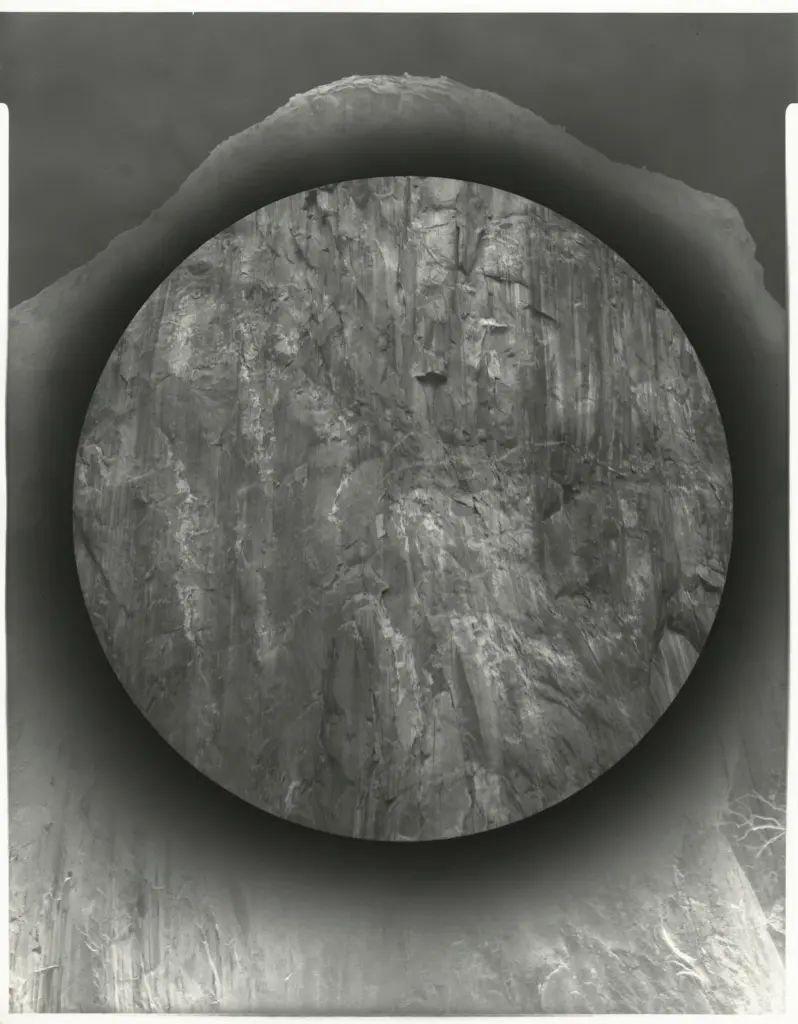
The newer Inverse series changes the equation without abandoning it. McCaw uses multiple exposures and custom-cut dark slides to produce shifts between positive and negative renderings of terrain. In Inverse #104, a sharply legible view of El Capitan sits like an oculus inside a darker, reversed field. The division is crisp but not merely graphic. It makes positive and negative coexist within one landscape, leaving neither version to behave as the image’s unquestionably stable side.
That experimentation now has institutional backing. McCaw received a 2026 Guggenheim Fellowship in Photography, and his official site identifies the grant as support for Inverse. SF Camerawork also recently presented Chris McCaw: Double Day, which ran from May 21 through June 21, 2026. The exhibition has closed, but the work’s practical question remains open: how much sunlight can a photograph hold before the record of a landscape becomes a visibly altered object?
McCaw’s pictures keep ordinary landscape elements intact—a horizon remains a horizon, a tree remains a tree—while making the conditions of photography difficult to ignore. Light, time, heat, and the fragility of the paper are no longer hidden behind the finished view. Look again at the bright mark. It has not been placed over the landscape as an embellishment. The scene and the photographic surface have both been acted upon by the same sun.
Sources and further looking
- About Sunburn — Chris McCaw
- Sunburned, GSP #166, Mohave/Winter Solstice — The Metropolitan Museum of Art
- Chris McCaw: Double Day — SF Camerawork
- Inverse — Chris McCaw
- Announcing the 2026 Guggenheim Fellows — John Simon Guggenheim Memorial Foundation
- Chris McCaw — Chris McCaw
- Sunburn — LensCulture
- Artist Profile: Chris McCaw — Squarecylinder
Images are shown for editorial commentary and remain the property of their respective artists and photographers. Please contact Woke a Doodle regarding attribution, correction, or removal.